A recent collaboration between Bluetech and International Seaways (INSW) has provided new insight into how wind-assisted propulsion can contribute to future tanker efficiency. Using Bluetech’s SeaWasp concept, the partners explored whether designing a vessel specifically around wind power—rather than adapting an existing hull—could deliver measurable benefits. The results indicate that it can.
Purpose-Designed for Wind Integration
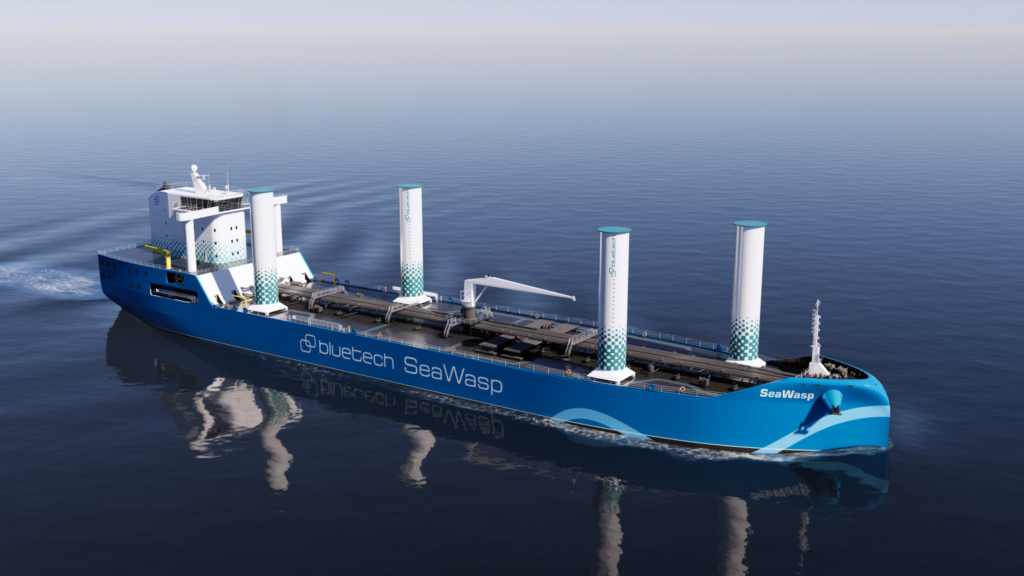
The study centred on a modified version of Bluetech’s BT50 MR tanker design, developed with input from Norsepower. Two large Rotor Sails™ were incorporated into the concept with the aim of maximising forward thrust. On one representative Pacific trade route, simulations showed a reduction of up to 876 kW in propulsion power demand, equivalent to around 600 tonnes of annual fuel savings.
A portion of this gain came directly from structural and hydrodynamic adjustments made to support wind performance—illustrating that design integration itself can provide efficiency improvements.
Real-World Operating Conditions as a Benchmark
To maintain realistic expectations, the analysis covered a wide range of MR tanker routes and weather patterns. Routes with less favourable winds still showed notable, though smaller, reductions in fuel use—for example, around 186 tonnes per year on the South Korea–Singapore route.
By testing across both high- and low-potential scenarios, the project offered a balanced view of the technology’s achievable impact.
Efficiency Beyond Wind Power Alone
The underlying BT50 platform is already more efficient than typical tankers of its size. Additional improvements were introduced for the SeaWasp concept, including an aerodynamic deckhouse and a new underwater fin configuration known as blueSURF. CFD modelling suggested these fins could reduce power demand further, supporting the overall case for design-driven efficiency gains.
Exploring Rotor Sail Options
The research also compared different wind-propulsion layouts, including two 35-metre Rotor Sails™ versus four smaller units. Each setup performed better under certain wind conditions, although the larger pair produced the highest peak savings and offered a more straightforward installation approach.
Broader Implications for Energy Transition
The findings add to a growing body of evidence showing that wind-assisted propulsion can play a meaningful role in reducing energy demand in deep-sea shipping. Importantly, the project suggests that integrating wind considerations into the initial vessel design—rather than relying solely on retrofits—may unlock additional efficiency gains.
As the sector works toward lower-emission fleet designs, studies like this offer practical insight into how traditional tanker architecture may evolve to incorporate renewable propulsion support.