Allseas has released the results of an independent impact study by strategic consultancy Roland Berger, revealing that Small Modular Reactors (SMRs) could become a defining technology for the global marine energy transition. The study confirms that Allseas’ offshore-ready nuclear technology can significantly reduce maritime emissions, unlock clean power for vessels and ports, and accelerate the shift toward a low-carbon marine industry — while delivering major economic value for the Netherlands.
The findings reinforce the direction set by Allseas when it launched its five-year SMR development programme in June 2025. The company is designing a compact 25 MWe / 70 MWt high-temperature gas-cooled reactor (HTGR), engineered specifically for offshore deployment and integration into maritime operations. Allseas is developing the reactor together with NRG PALLAS, TU Delft and other partners, with the first units expected to be operational by 2030.
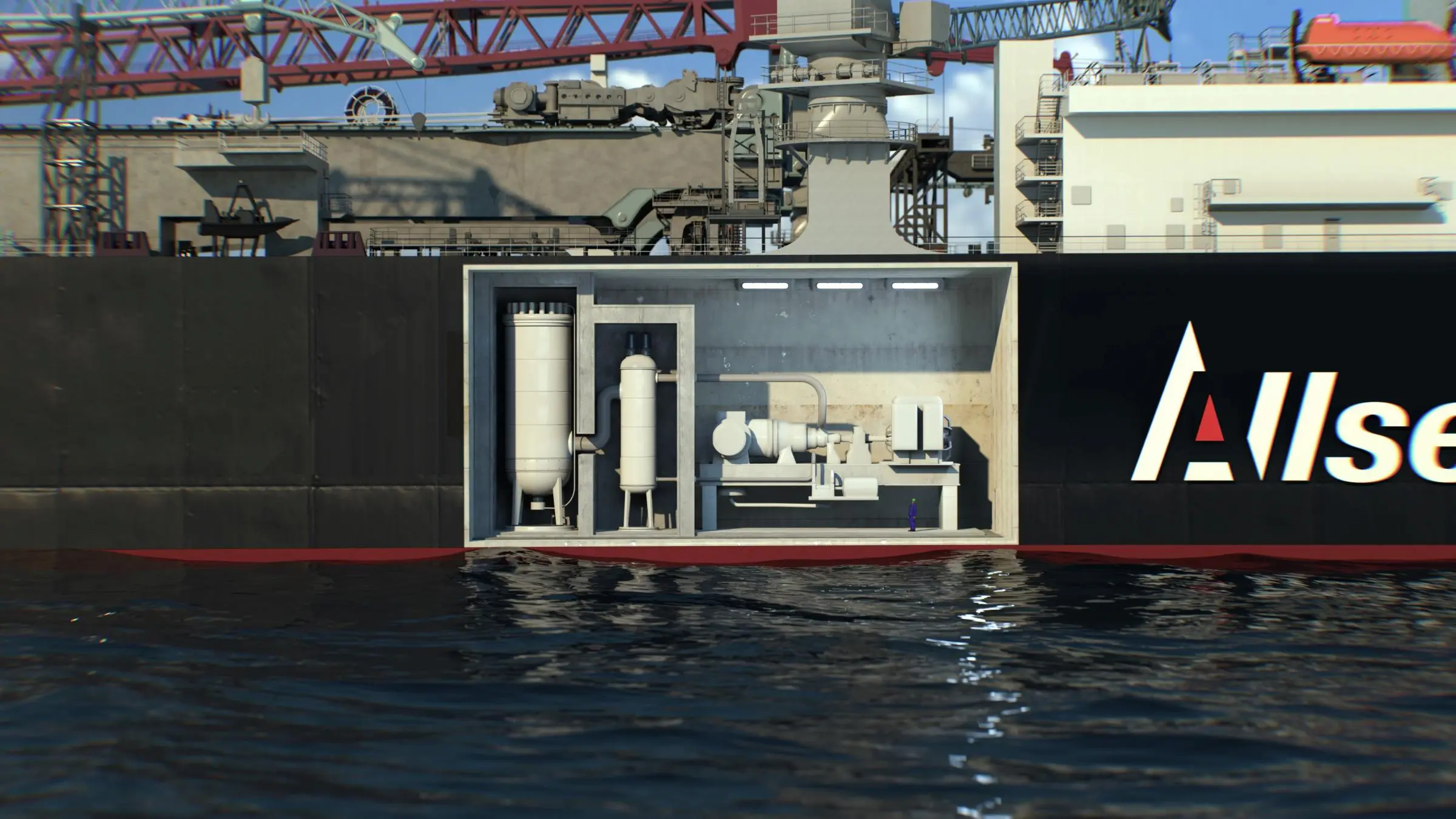
Powering the future of the maritime sector
Allseas’ SMR is designed for the demanding realities of the marine environment. Its intrinsically safe, compact and scalable design makes it suitable for a wide range of maritime applications, including:
- Zero-emission propulsion for large commercial vessels
- Continuous clean power for offshore operations, including construction vessels and floating assets
- Decarbonised energy supply for ports, terminals and bunkering hubs
- Dedicated electricity and heat for maritime-linked industries, such as shipyards, refineries and logistics clusters
The technology also offers a stable power source for the digital and high-performance computing systems increasingly used in maritime operations — from autonomous vessel control systems to real-time offshore monitoring platforms.
Roland Berger estimates the potential deployment of up to 700 Allseas SMRs in the global maritime sector, in addition to 110 onshore units across the Netherlands.
A catalyst for greener global shipping
According to the study, Allseas’ SMR technology could reduce emissions in the global maritime sector by up to 55 megatons of CO₂ per year by 2050, equivalent to the annual emissions of more than 3 million Dutch homes. This positions SMRs as one of the few scalable solutions capable of delivering deep decarbonisation for long-distance shipping, offshore operations and heavy-duty marine assets — segments that are difficult to electrify or convert to alternative fuels.
By providing continuous carbon-free power, SMRs eliminate the need for fossil bunkers and drastically reduce operational emissions, marking a major step toward IMO 2050 climate targets.
Strengthening the Netherlands as a global marine energy hub
The study highlights that widespread SMR deployment could contribute up to €130 billion to the Dutch economy by 2050, with strong benefits for the maritime sector. This includes retaining 10,000–15,000 jobs and creating 35,000–40,000 new high-skill roles across shipbuilding, offshore engineering, port operations and nuclear technology manufacturing.
Because SMRs generate clean energy at the point of use, they also help alleviate grid congestion, which currently limits growth in Dutch ports and offshore energy clusters. According to the study, this decentralised SMR power supply could unlock €40 billion in additional economic activity and avoid €12 billion in grid investments.
Energy security for offshore operations and ports
The Allseas reactor delivers reliable, dispatchable power and high-temperature industrial heat at competitive cost levels. For the marine sector, this offers:
- Stable offshore energy for continuous operations
- Reduced dependence on volatile fuel markets
- Increased resilience for port infrastructure
- Lower operational costs for maritime industry clusters
This combination of stability, affordability and autonomy strengthens energy security for both offshore operations and coastal industrial regions.
Enabling a global transition in maritime energy
“This study shows that our small modular reactor is not only technologically innovative, but strategically important for the future of the maritime sector,” says Stephanie Heerema, Project Manager Nuclear Developments at Allseas. “SMRs give the marine industry access to stable, clean and affordable energy — a critical requirement for achieving deep decarbonisation.”
About the study
Roland Berger conducted the impact study with input from leading research and industry organisations including TNO, COVRA, Urenco and the Port of Rotterdam. Their validation provides a solid foundation for Allseas’ continued development of SMR technology.
“As a long-term oriented family company, we look beyond today’s challenges,” Heerema adds. “The conclusions of this study confirm the enormous potential of SMRs to accelerate the marine energy transition and strengthen our commitment to delivering on our five-year plan.”